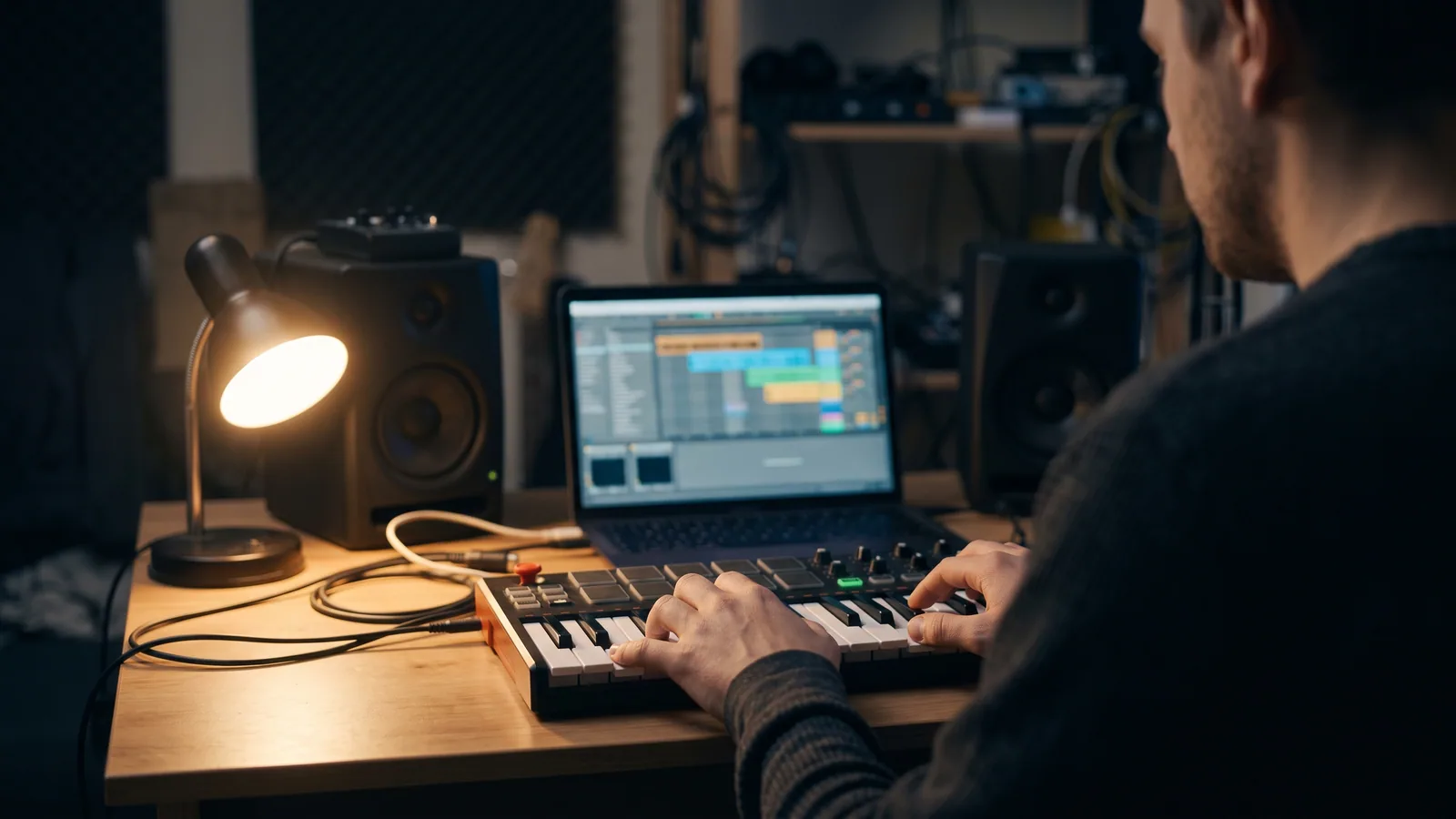
67 MUSIC, the music studio inside Shela, built by the studio that publishes SheAI News, tries to cover the whole path from idea to release in one conversation: it invents an artist, writes the lyrics first, renders and masters the song, then opens it as separate tracks in a browser studio and cuts a vertical video to the beat.
The about page puts it in one line: "Say it to Shela. Hear it in seconds." Here is the path step by step, as the pages and the app showed it on 1 October 2026.
An artist, drafted first
A request can start with a person instead of a song. Asked for an artist, Shela invents one: name, home city, look, voice, sound rules, channels and label, with a painted portrait. Every later song under that name reuses those rules, so the voice stays consistent.
Since 30 September a new persona starts as a free draft that ends with "Say go or change anything." It is created only after that reply, unless the user asks to skip the draft. A real artist named as a reference is treated as a style, not copied as a name. A song without an artist works too.
Who it is for
The about page names four groups: songwriters and independent artists who want a finished, mastered song from lyrics they approve; producers and DJs who need a track for a set, a vocal for their own beat or ideas in their genre; creators who need a song and a video for short posts on the same afternoon; and anyone inventing an artist, from one character to a whole roster on a label.
It also shows three ways people start: one sentence that orders an artist with a portrait and two finished tracks, a request for three song ideas with full lyrics and the strongest one rendered, or a two minute intro for a DJ set together with a version without the vocal. Your own material can be the starting point too: the page says a recording, a demo or stems can be uploaded, the plan extracted from it edited, one section regenerated or the song extended.
Lyrics before sound
67 MUSIC writes the lyrics first and shows them in the chat; nothing is rendered until the user approves or changes them. The rules are short:
One feeling per song. A chorus you can sing in one breath. One image per line, a concrete detail as proof.67 MUSIC about page, read 1 October 2026
The approved words and the artist's sound rules then become a composition plan: sections, styles, where the chorus and the hook land. The studio's comparison page gives the reason: with words and structure fixed first, "the engine has something specific to sing". That engine is Shela's 67 MUSIC engine.
The about page describes that engine in two layers. At the core is a music model that writes and performs complete arrangements with sung vocals, up to ten minutes long and up to 30 sections; on top sits Shela's own method: the lyrics, the plan, the mastering, the artist and the release. The vocal follows the language of the approved lyrics, English, Spanish, French, German and Japanese among many others, and the studio's own releases are sung in Serbian.
Rendered, mastered, filed
The song is rendered as a 44.1 kHz WAV with a title and cover art. A three minute song takes about 25 seconds, mastering included, the about page states. Before a render starts, the studio panel shows an estimate in credits next to the user's balance.
Mastering is automatic and aims at "the level streaming services expect, dynamics kept". Each song also gets a measured profile of tempo, key and loudness.
Library, Explore and the chart
Songs land in the library and on the artist's page, private until published. Published songs appear in Explore and on the public chart, which play without an account. A private song stays out of both, but its share link still plays, by design.
The player has a tempo fader of plus or minus 16 percent and a Master Tempo switch, familiar from DJ decks, that keeps the vocal on pitch. Songs download as WAV or MP3, with no download cap on any plan, the comparison page states, and four stems plus a MIDI file are available for any song.
AI made tracks carry a small AI badge ("Made with AI on 67 MUSIC"). The public catalogue is still small: on 1 October the chart listed three public artists, among them the studio's AI personas Zora Savić and Eva Lin. On 1 October Zora's song "Sunce Moje" got an AI generated music video. Related: who Zora Savić is and making a song and a clip, step by step.
Wave: the song as tracks
Wave, in production since 6 September, is a multitrack studio in the browser. One tap splits a song into four stems: drums, bass, vocals and everything else. The original stays untouched.
Each track gets an EQ with a live spectrum, a compressor with a gain reduction meter, sidechain ducking, saturation, delay and reverb, and the mixer ends in a master limiter. The about page also lists a piano roll, a step sequencer, 150 loops and chord detection. Musical typing, switched on with Cmd or Ctrl plus K, turns the computer keyboard into a piano.
For playing and programming, the page lists an on screen keyboard, drum pads and MIDI keyboard input, a synth with 30 presets, pianos, basses, strings and two drum kits, recording with a click and count in, a piano roll with quantize, swing and MIDI import and export, beat slicing, and a mastering assistant that brings a mix to streaming, club or podcast level. The page says the whole studio fits a six inch phone screen.
Video: cut to the beat
The Video editor, also in production since 6 September, knows the song's beats and the timing of every sung word. Cuts and effects snap to a beat grid, a Magic tool can cut the whole video to the beat, and karaoke captions follow the vocal word by word in five styles. The about page states 58 effects, 42 transitions and 10 looks; the vertical 9:16 format renders on the server at 1080 x 1920. The about page lists square 1:1 and wide 16:9 exports as well.
Users bring their own clips or let the editor generate clips from a shot plan that follows the lyrics. Before generation starts, it shows the price per clip in dollars and credits.
432 Hz, and what the studies say
Since 29 August the player retunes playback from 440 to 432 Hz with one tap, on by default; one more tap returns the standard version. The about page keeps the claim modest: 432 Hz "is not a medical claim", the studies are small and the mechanism is not explained.
Smaller clinical studies suggest modest effects. In a pilot study of 33 volunteers, Calamassi and Pomponi (2019, PMID 31031095) measured a mean heart rate 4.79 beats per minute lower at 432 Hz than at 440 Hz and called for larger trials. With 42 dental patients, Aravena and colleagues (2020, PMID 32401941) found lower salivary cortisol at 432 Hz, 0.49 against 1.35 µg/dL. Hohneck and colleagues (2025, PMID 39844155) reported lower pulse wave velocity after 432 Hz than after 443 Hz in 43 cancer patients. None of this is a health promise.
What is not pro yet
Wave does not replace a desktop audio workstation: on some computers it slows down while controls are dragged, and its limiter does not yet measure true peak. Video has no keyframes, masks or motion blur, and for some effects the preview does not yet match the export. The music is made by AI, and the about page notes that a similar song can be made for someone else. The comparison page adds that the studio does not claim its songs sound better: only a blind listening test with outside listeners could show that.
Prices and how to try it
The about page lists Free at USD 0, with a short song every day and Wave, Video and the chart included, and Pro at USD 35 a month, which covers all of Shela, with music metered per second. Details are on the pricing page.
To try it, open 67music.shela.ai, play a public track and switch 432 Hz off and on. Then sign in, describe an artist or a song in one sentence, approve the lyrics and listen.
SheAI News is published by the studio that builds this product.




Comments
Comments are reviewed before they appear.
No comments yet. Be the first to share your thoughts.