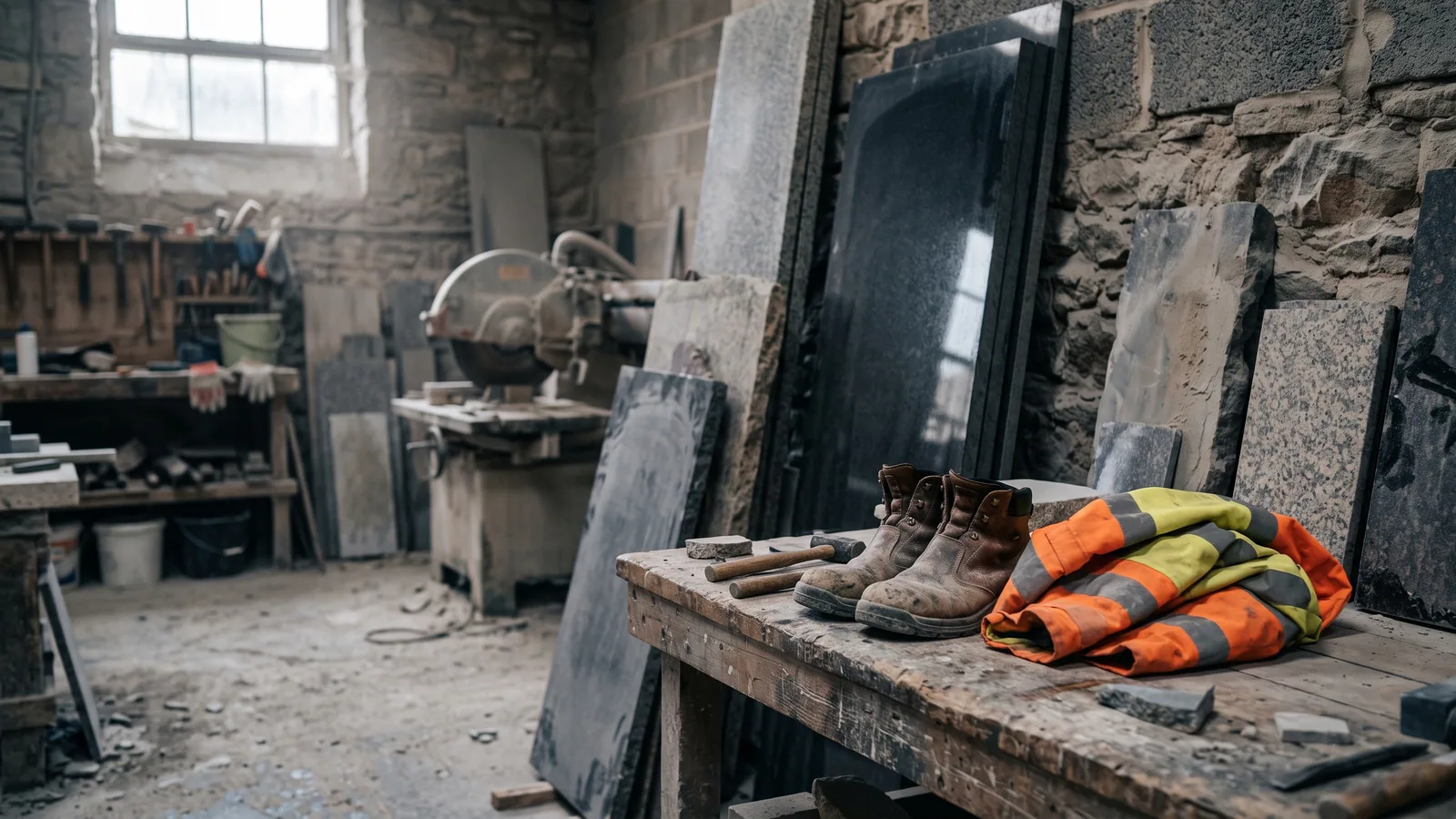
Two businesses far from the AI industry run on software built by the studio that publishes SheAI News: STONAR, a stone company in Maribor, Slovenia, whose online configurator turns a photographed measurement slip into a price, and Safe Workwear, a shop for companies that buy workwear, safety footwear and protective equipment, in Slovenian, English and German.
A price without the phone call
STONAR makes gravestones, kitchen worktops, window sills, stairs and other pieces in natural stone and porcelain, cut to measure. Its homepage sums up the business as "craft, precision, 25+ years", with everything from cutting raw blocks to the final finish done in house.
Ordering stone used to go like this, as a STONAR guide of 5 August 2026 puts it: measure, write the numbers on a slip, call, explain, then wait a day, two, sometimes a week for a quote. The configurator shortens that. A customer photographs the slip with a phone and uploads it; according to STONAR, the software reads the dimensions from the paper, and once the stone and the thickness are chosen, the area and the price are calculated in real time.
Artificial intelligence reads the dimensions directly from the slip, even if it is handwritten.STONAR guide, 5 August 2026 (translated from Slovenian)
The configurator first asks what is needed: a gravestone, meaning a complete monument installed at the cemetery, or other stonework such as window sills, worktops and steps. For stonework, pieces are entered one by one, polished edges are marked on a drawing, and the slip can be attached as a photo, a PDF or a spreadsheet.
Gravestones get a starting price rather than a final one. The page on gravestone prices explains why: a gravestone often brings extra work, such as removing the old monument, building a foundation and installing the new stone, so the final offer is prepared once the state of the grave site is known.
The homepage speaks of 40 types of granite and porcelain in seven thicknesses; the materials page lists 38 kinds of stone in stock, and the configurator offers them from 2 to 12 centimetres thick. A separate portal lets registered stonemasons, carpenters and builders see trade prices, stock and an online configurator.
Guides for the questions families ask
STONAR's page on additional inscriptions deals with the most common job, which is not a new monument at all: adding a name to a stone that already stands on a grave. The new letters are cut in the same typeface and depth as the old ones, the page says, so the monument does not look repaired. Gilding and silvering are priced per letter.
A guide on ash scattering names what is rarely discussed before a funeral: after scattering there is no grave, no stone and no place for the family to visit on an anniversary. STONAR states that it does not carry out scattering; it makes what remains for the family, from inscriptions and memorial plaques to a QR plaque that leads to an online memorial profile. The blog, running since August 2026, covers urn graves, cemetery rules, worktops and stone care.
A gallery of 202 digital designs, 159 gravestones and 43 crypts and mausoleums, shows a monument before anything is carved. The page is candid: the stone comes very close to the picture, but it is not an exact copy.
The bridge to Memoris, the studio's memorial platform, sits on STONAR's homepage under the label "coming soon": QR code plaques, a white ceramic heart or a black engraved stone, that link a gravestone to a memorial profile with photos, a life story and the name.
Safe Workwear: from PDF catalogues to a shop
Safe Workwear went live on 5 September 2026. The studio built it for a partner company, which owns and runs the shop. Its homepage promises "over 290 products, 14 catalogues with prices, quote within 48 hours".
The product pages were built from the suppliers' catalogues, with the images extracted from them automatically, and each one still points to its origin: a white rubber safety boot, for example, names the footwear catalogue and the page it comes from. The 14 catalogues can be browsed page by page or downloaded as PDF files. Footwear is the largest category, with 86 products.
Buyers of protective equipment work with standards, not adjectives. "Procurement managers search for 'S3', not 'high-quality footwear'," the homepage puts it, and a glossary of standards explains each marking briefly: EN ISO 20345 for safety footwear, whose toe cap must withstand an impact of 200 joules; EN ISO 20471 for high visibility clothing; EN ISO 11612 for heat and flame; EN 388 for gloves.
Ordering works like a basket: the buyer picks a size and a colour on each product page and adds pieces. The order page sets a minimum order value of EUR 300 excluding VAT; submitting is not a binding purchase, and within 48 hours the shop confirms availability, delivery time and the final quote. Logo embroidery and printing, custom made earplugs and orthopaedic insoles are offered on request.
Two trades, one pattern
Both projects take what used to live on paper, a handwritten slip or a PDF catalogue, and turn it into something a customer can use without a phone call. Neither takes the people out: STONAR confirms every enquiry with a quote, and Safe Workwear confirms every order within 48 hours.
How to try it
Open the STONAR configurator, choose "Other stonework", pick a granite and a thickness and enter a size, or upload a photo of your own measurement slip, to see a price. The homepage and the configurator are also in English; the guides are in Slovenian. For Safe Workwear, open a catalogue or a product at safeworkwear.eu, in English, Slovenian or German, and add sizes to an order.




Comments
Comments are reviewed before they appear.
No comments yet. Be the first to share your thoughts.