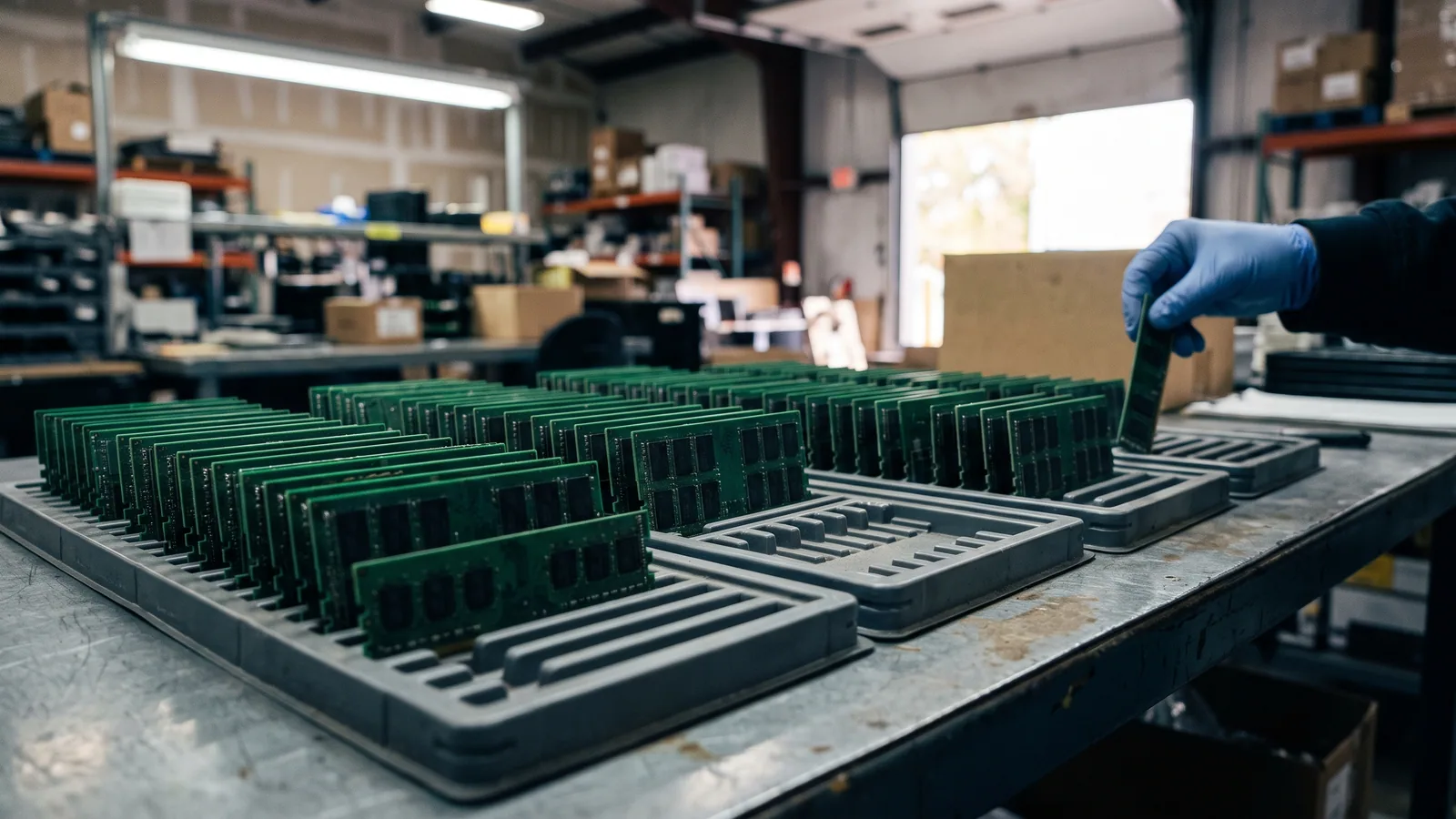
A year ago Micron sold USD 11.3 billion worth of memory chips in a quarter. In the three months to 3 September 2026 it sold USD 54.2 billion, and kept 86.8 percent of that as gross profit, up from 44.7 percent a year earlier.
The results, published on 30 September, put the clearest number yet on the memory shortage created by AI data centres, and Micron's message was that it will get worse before it gets better. Chief executive Sanjay Mehrotra told analysts that "we do not have line of sight to when supply and demand will return to balance", and that he expects conditions in fiscal 2027 and 2028 to be "much tighter" than in 2026. For buyers of servers, phones and laptops, that points to memory staying expensive.
- Results: Revenue of USD 54.23 billion in the quarter to 3 September, against USD 11.32 billion a year earlier; guidance of USD 61.5 billion for the next quarter.
- Prices: TrendForce expected contract prices for conventional DRAM to rise 58 to 63 percent in the second quarter and another 13 to 18 percent in the third.
- Why it matters: AI servers are taking memory that used to go into phones and PCs, and Micron cannot say when supply will catch up, even as new factories start up from 2027.
A memory maker with record margins
Micron's earnings release shows GAAP net income of USD 37.70 billion for the quarter, more than the company's entire revenue in fiscal 2025 (USD 37.38 billion). Revenue for fiscal 2026 reached USD 133.19 billion. For the current quarter, the first of fiscal 2027, it guided to USD 61.5 billion, plus or minus USD 1.5 billion, above the USD 57.02 billion analysts expected according to LSEG data, Reuters reported; the quarter just ended also beat the USD 51.07 billion consensus.
The boom was not limited to data centres. Revenue in Micron's core data centre unit rose to USD 18.0 billion from USD 1.6 billion a year earlier, but the unit that sells to phone and PC makers also more than tripled, to USD 13.1 billion, at a gross margin of 90 percent. That is the bill the rest of the electronics industry is paying for the AI build out. "AI is becoming Super Intelligence (SI), and memory enhances this intelligence and the competitiveness of our customers' platforms," Mehrotra said in the release, using the label that a US executive order of 29 September told federal agencies to use in place of AI, as Freshfields summarised it.
Why prices keep climbing
The squeeze starts with where the factories send their output. The market research firm TrendForce wrote on 3 July that "ongoing capacity reallocations toward server applications are reducing the supply available for PC DRAM". In March it had forecast that contract prices for conventional DRAM, the ordinary working memory in servers, PCs and phones, would rise 58 to 63 percent in the second quarter alone, with NAND flash storage up 70 to 75 percent. When the quarter was over, it counted DRAM industry revenue of USD 154.73 billion, up 59.5 percent on the first quarter. Micron is the smallest of the three big DRAM makers, with 23.3 percent of that revenue against 39.4 percent for Samsung and 24.9 percent for SK hynix.
Phones took a direct hit. TrendForce expected prices of LPDDR5X mobile memory to jump 78 to 83 percent in the second quarter and said brands would cut smartphone production in 2026; with prices that high, 12GB was becoming the standard in high end phones as 16GB faded, and mid range models were going back to 8GB. For the third quarter it forecast slower increases, 13 to 18 percent for conventional DRAM and 10 to 15 percent for NAND, because buyers of PCs and smartphones were "reaching their affordability limit". Smartphone vendors, TrendForce wrote, were expected to raise retail prices in the third quarter to offset persistently high memory costs.
Sold out into 2027
For the memory that matters most to AI, the shortage is already written into next year's contracts. "We have completed agreements for the vast majority of our calendar 2027 HBM bit supply," Mehrotra said on the call, according to a transcript published by Investing.com, adding that prices rose significantly from a year earlier. HBM, high bandwidth memory, is the fast memory built into AI accelerators, and Micron, a key supplier to Nvidia, is the only major HBM maker based in the United States, Reuters noted. Micron is ramping production of the newest generation, HBM4.
Customers are paying in advance to secure supply. Micron has signed 26 strategic customer agreements that it estimates will cover more than 35 percent of its revenue through 2030, and customers' financial commitments under them have risen to USD 32 billion, mostly as cash deposits. All of them have take or pay contracted volumes, chief financial officer Mark Murphy said, meaning buyers pay for the contracted amount whether or not they take delivery.
New capacity is coming, slowly. Micron spent USD 27.37 billion on capital investment in fiscal 2026 and expects about USD 25 billion in the first half of fiscal 2027 alone. Its HBM packaging plant in Singapore is due to start output in early 2027, the first new fab in Idaho in mid 2027, a second Idaho fab and a DRAM expansion in Japan in late 2028, and the New York site in 2030, according to Micron's presentation as summarised by Investing.com.
The memory makers' new weight shows up in the money around AI labs too: Micron, Samsung and SK hynix joined Anthropic's USD 65 billion funding round in May as strategic partners. For people buying a phone or a laptop, the date that matters is later. Micron expects supply to be tighter in fiscal 2027 and 2028 than in 2026, and its first new Idaho fab will not produce wafers before mid 2027.



Comments
Comments are reviewed before they appear.
No comments yet. Be the first to share your thoughts.