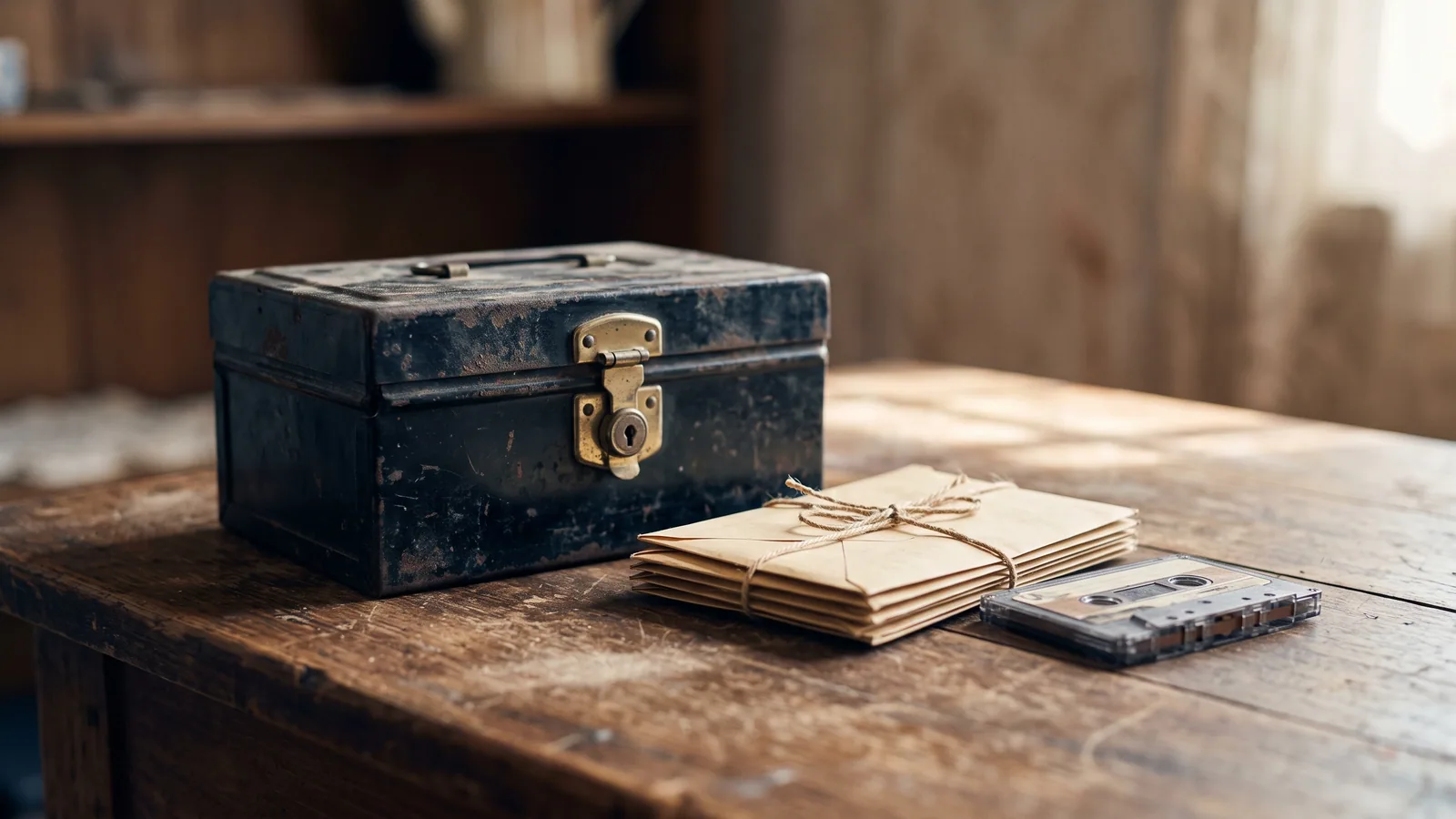
Some messages are written for later: a letter a child will open on an eighteenth birthday, a group's predictions for a reunion ten years away, the stories a grandfather wants his family to hear when they are ready. Time Capsules, part of the Memoris memorial platform from the studio that publishes SheAI News, are built for that kind of message. You fill a capsule, choose the moment it opens and seal it. Until that moment, nobody can see inside.
The feature has been in production at memoris.io/time-capsules since 10 August 2026, and since 18 August the contents of capsules have been encrypted at rest with AES-256. Here is how a capsule is made, and what its encryption and fingerprint protect, in plain terms.
Four steps, one path
The page sets out the same four steps for every capsule.
Create. Give the capsule a name and a message, then add what should travel with it: a photo, a video, a voice note or a document.
Set the moment. Choose when it opens: a birthday, an anniversary or a distant year, "days, months or decades". The page's FAQ adds that you pick the exact date and time, and the capsule counts down to the second.
Address. Send it to one person, to several, or to a whole circle, and leave a window open so they can add their own pieces before it closes.
Seal. When the window ends, the capsule seals. "Nothing more goes in or out until the day it was made for," the page says.
What fits inside
A capsule can hold a letter of up to 20,000 characters, voice notes, video, photographs and documents. The page also lists digital keepsakes, "the digital things a family would otherwise lose track of". A voice note, it says, is recorded once and "plays back on the day, unchanged".
Filled by a group, no account needed
What separates a capsule from a scheduled email is that other people can add to it. While a capsule is open, everyone invited can drop in their own messages, photos and files. They do not need a Memoris account, either to contribute or to read the capsule on the day it opens.
The creator decides how long the window stays open: "24 hours, a week, up to a month", in the page's words. When it ends, the capsule seals itself automatically, and the creator can also seal it early with one click. One example on the page, marked as illustrative, is a group of friends who spend one open week adding photos, inside jokes and a prediction each, then wait ten years for their reunion.
Countdown and unlock day
The people a capsule is addressed to receive an email when it is sealed, or an invitation while it is still open for contributions, and another email at the moment it opens. Until then, the page says, nobody can see what is inside, "not even you": the countdown is visible, the message, files and contributions are not.
Sealing is also final. "A sealed capsule can't be edited, that's the point of it," the FAQ states. The remedy on offer is a new capsule for the same people and the same day.
What "sealed" means technically
Sealed means sealed. Your words are encrypted at rest with AES-256. Nobody can read them in the database, and every sealed capsule carries a SHA-256 fingerprint, so tampering would show.Memoris Time Capsules page, memoris.io/time-capsules, read 1 October 2026
Encryption at rest concerns the stored copy. AES, the Advanced Encryption Standard, is a block cipher published by the US National Institute of Standards and Technology (NIST) as FIPS 197. The standard specifies three versions, AES-128, AES-192 and AES-256, and the number gives the length of the key in bits, so 256 is the longest of the three. Stored in encrypted form, a letter cannot be read in the database, which is exactly what the page claims for capsules.
The fingerprint is about integrity, not secrecy. SHA-256 is one of the hash algorithms in NIST's Secure Hash Standard, FIPS 180-4. It turns content into a condensed value called a digest, and the standard explains why that helps: "any change to the message will, with a very high probability, result in a different message digest". If the contents of a sealed capsule were altered, they would no longer match the fingerprint the capsule carries.
What the protection does not do
Both mechanisms have limits. A fingerprint does not stop a change. The standard describes digests as a way "to detect whether messages have been changed", which makes tampering visible, not impossible.
Encryption at rest protects the stored copy. The page does not describe capsules as end to end encrypted; what it promises is that the contents cannot be read in the database and are decrypted "only for you and, on the day you chose, for the people you chose". And because a sealed capsule cannot be edited, a mistake in a letter stays sealed with it.
How to try it
Time Capsules are at memoris.io/time-capsules. A capsule belongs to a Memoris account, "so it can find you (and your people) when it opens", so the creator signs in first; invited people need no account. Choose "Seal your first capsule" and start small: a short letter and one voice note for a birthday next year.



Comments
Comments are reviewed before they appear.
No comments yet. Be the first to share your thoughts.